Launch-Ready Spaces: Designing a Home Office That Looks Like You Mean Business (Without the Corporate Price Tag)
There's a particular kind of dread that comes with setting up your first serious home office. You want it to look professional — something you could have a Zoom call in without apologizing for the background. You want it to reflect your actual taste, not a generic "productivity setup" from a listicle. And you want to do all of that without spending money you don't yet have, because you're building something, and building things costs money in other places first.
This is the design problem that a lot of young entrepreneurs and freelancers are navigating right now, and it's a more solvable problem than it looks. The key is understanding that contemporary design — real contemporary design, not the stuff that just calls itself that — is fundamentally about intention. And intention doesn't have a price floor.
Start With the Story You Want to Tell
Before you buy a single piece of furniture, spend ten minutes thinking about what your space needs to communicate. Not just to clients or collaborators who might see it on a video call, but to yourself, every day when you sit down to work.
Are you a creative professional whose work is rooted in craft and materiality? Your space should probably have warmth — natural wood, tactile textiles, a few carefully chosen objects that signal a hand-made sensibility. Are you building something in tech or strategy, where precision and clarity are the point? Clean lines, minimal surfaces, and a restrained palette will serve you better than anything decorative.
This isn't about performing a version of yourself. It's about creating an environment that reinforces the mindset you need to do your best work. The furniture you choose is just the physical expression of that.
The Non-Negotiables: What to Spend On
When your budget is limited, prioritization is everything. There are exactly two pieces of furniture worth spending real money on in a home office: your chair and your primary work surface.
Your chair, because you'll spend more hours in it than almost anywhere else, and a bad chair doesn't just hurt your back — it degrades your focus and energy in ways that compound over time. Look for contemporary ergonomic options that don't sacrifice design for function. Brands like Branch, Autonomous, and Humanscale offer genuinely supportive seating that won't make your office look like a corporate HR department. Spend what you can here. It's not a luxury.
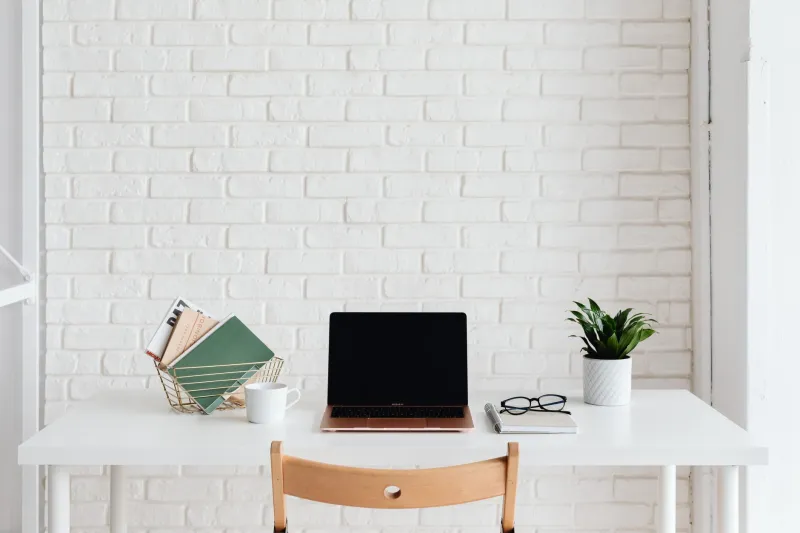
Your desk, because it's the visual anchor of the entire space and the surface where everything actually happens. A desk with a clean, contemporary profile — simple legs, a surface with some visual weight, minimal hardware — will photograph well, age well, and work with nearly any future furniture decisions you make. Solid wood or a quality laminate over a real wood core are both defensible choices at different price points. What to avoid: anything with obvious particleboard edges, wobbly assembly, or styling that's trying too hard to look expensive.
Where to Save (And Still Look Sharp)
Everything else in the space — shelving, storage, lighting, accent seating — is where you can be creative with your budget without it showing.
Open shelving is one of the most cost-effective ways to add vertical interest and visual depth to a home office. A simple floating shelf system in natural wood or matte black metal reads as intentional and contemporary at a fraction of the cost of built-ins or furniture-grade bookcases. Style it with a mix of functional items (books, binders, equipment) and a few personal objects that add character without clutter.
Lighting is criminally undervalued in home office setups. A well-chosen desk lamp and a floor lamp in the corner will do more for the look and feel of your space than almost any other single purchase. Look for fixtures with clean geometric forms and warm-to-neutral bulb temperatures. Avoid anything that looks like it came from a hospital supply catalog.
The secondhand market is your friend for accent pieces. A vintage wooden filing cabinet, a mid-century side table, a sculptural plant stand — these kinds of finds add personality and visual texture that new furniture rarely achieves at the same price point. Apps like Chairish, Facebook Marketplace, and local vintage shops are worth an hour of browsing before you commit to buying anything new.
Creating Zones in a Small Space
If your home office also needs to function as a living space, a guest room, or a creative studio, zoning is the design skill that holds everything together.
The goal is to create psychological separation between different modes of your day without building walls or sacrificing square footage. A few strategies that work particularly well in contemporary settings:
- Use a distinctive area rug under your desk setup to visually anchor the work zone and separate it from the rest of the room.
- Face your desk away from your leisure seating — even a 45-degree angle creates meaningful psychological distance between work and rest.
- Use a bookshelf or open shelving unit as a room divider if the space allows. It provides storage, adds visual interest, and creates a soft boundary between zones without blocking light.
- Designate one surface as completely work-free. A small side table, a coffee bar setup, or even just a chair in a corner with a lamp — having one spot in the room that's explicitly not for work gives your brain somewhere to land when you need a break.
The Zoom Background Problem (And the Real Solution)
Let's be honest: for a lot of freelancers and entrepreneurs, the video call background is a real concern. Clients form impressions fast, and a chaotic or generic background undermines credibility before you've said a word.
The solution isn't a virtual background. It's a real one — a small section of your space that's thoughtfully arranged and reliably presentable. A wall with a couple of framed prints at consistent heights. A bookshelf with curated objects. A plant with good structure. Nothing that requires explanation or apology.
This is where contemporary design thinking is genuinely useful: edit down to what matters, make every visible element earn its place, and let the overall composition do the talking. A simple, well-considered background communicates competence and taste more effectively than any elaborate setup.
Growing Into the Space
Finally, give yourself permission to start incomplete. The best professional spaces evolve over time — you add a piece when you find the right one, you swap something out when your needs change, you gradually develop a more refined sense of what works for you and your work.
The trap is trying to create a finished, fully realized space all at once, which usually means compromising on quality or coherence because you're trying to fill every corner at once. Start with the essentials, do them well, and let the rest come. That patience, applied to your space the same way you'd apply it to building a business, is how genuinely great interiors actually get made.