Build It Your Way: The Rise of Modular Furniture and the End of the 'Forever Room'
For decades, buying furniture felt like signing a contract. You picked the sofa, you placed it against the wall, and — barring a major life event — it stayed there until someone moved out or the fabric gave up. That era is quietly, confidently coming to an end.
Modular furniture is reshaping the conversation around home design, and not in a gimmicky, IKEA-hack kind of way. We're talking about thoughtfully engineered systems — sectionals that split and reconnect, shelving units that climb or sprawl depending on your wall, bed frames that convert as family dynamics shift. The idea isn't novelty. It's practicality dressed up in genuinely great design.
Why 'Commitment' Got a Bad Reputation in Home Décor
There's a reason so many Americans keep their living rooms essentially unchanged for years at a time. It's not laziness — it's the math. Buying new furniture is expensive. Moving it is a headache. Getting rid of pieces that don't fit anymore feels wasteful. So most people default to neutral, generic, and static — choosing rooms that offend no one and inspire no one either.
The problem is that life doesn't stay static. You get a roommate, then lose one. You start working from home. You have a kid, or your kid leaves. The room that made sense at 27 can feel like a stranger's space by 34. Traditional furniture forces you to either live with the mismatch or spend money you don't necessarily have to fix it.
Modular design offers a third option: furniture that's built to change.
What 'Modular' Actually Means (Beyond the Buzzword)
The word gets thrown around a lot, so it's worth being specific. True modular furniture is designed with interchangeable, standardized components that can be rearranged, added to, or reduced without losing visual cohesion. It's not just a sectional with a movable ottoman — though that counts. It's also:
- Configurable shelving systems like those from String, VITSŒ, or the growing number of US-based brands offering wall-mounted grid frameworks that let you mix shelves, cabinets, and desks in the same footprint.
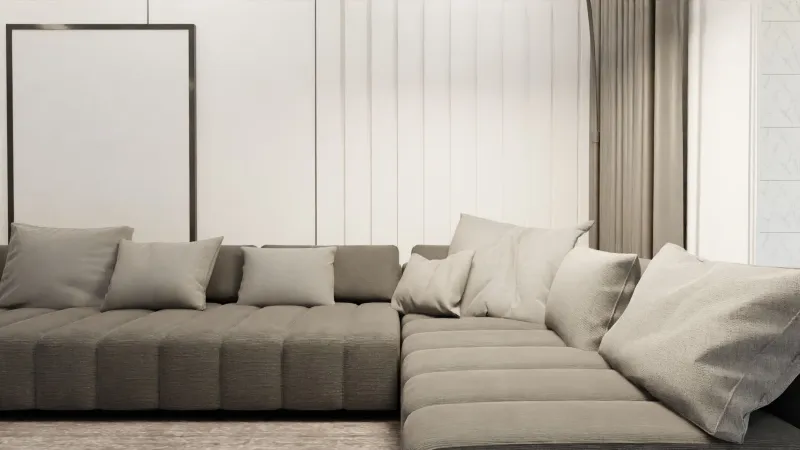
- Sectional seating with true modularity, where each seat, armrest, and chaise is a standalone unit that connects to any other piece in the system.
- Modular bedroom furniture that lets a platform bed expand with a trundle, integrate nightstands, or accept a headboard panel years after the original purchase.
- Stacking and nesting storage that scales as your needs do — starting with two units and adding four more without the whole thing looking cobbled together.
The key is that these pieces are designed together, not just sold together. That coherence is what separates genuinely modular systems from furniture that just happens to be in the same collection.
The Young Professional Effect
If you want to understand why modular design is having a serious moment, look at who's furnishing homes right now. Young professionals in their late 20s and 30s — especially those in cities like Austin, Denver, Chicago, and the New York metro area — are navigating housing markets that don't exactly reward permanence. Renting is extending into people's 30s. Remote work means home offices can appear and disappear with a job change. Urban apartments give way to suburban houses, which eventually might downsize again.
For this demographic, the idea of buying a room's worth of matching furniture and keeping it forever doesn't just feel financially risky — it feels philosophically wrong. Flexibility is the point. The ability to reconfigure a living room for a dinner party on Friday and a co-working setup on Monday isn't a luxury feature. It's a baseline expectation.
Brands like Burrow, Floyd, and Maiden Home have built real followings by speaking directly to this mindset. Their marketing doesn't sell permanence — it sells adaptability. And it's working.
How Modular Design Supports Your Mental Space, Not Just Your Physical One
Here's something that doesn't get discussed enough: the psychological weight of a room that doesn't fit your life anymore. Design and wellness researchers have long noted that cluttered, dysfunctional, or aesthetically mismatched spaces contribute to background stress — the low-grade kind you can't quite name but definitely feel.
When your furniture can't adapt, you often end up adapting around it. You stop using the formal dining room because it's too stiff. You pile things on the sectional because there's nowhere else to put them. The space starts working against you instead of for you.
Modular systems give you the agency to fix that without a full overhaul. Moving a shelving unit from the living room to the home office, splitting a sectional to create two seating zones, adding a storage module when a baby arrives — these are small interventions with real psychological payoff. Your space starts feeling responsive. Alive. Actually yours.
Making the Switch: A Practical Starting Point
If you're curious about integrating modular pieces but not ready to overhaul everything at once, here's a low-risk way to begin:
Start with the piece that frustrates you most. Is it the shelving situation that's never quite right? The sofa that's too big for your current apartment but would be too small if you moved? Identify the specific pain point before shopping — it'll keep you from buying flexibility you don't actually need.
Think in systems, not single pieces. The real value of modular furniture compounds over time. When you buy into a system, you're investing in future configurations, not just today's arrangement. Ask yourself whether the brand you're considering has a track record of keeping components available for years.
Don't sacrifice aesthetics for function. Modular doesn't have to mean utilitarian. Some of the most beautiful contemporary furniture on the market right now is modular — clean lines, quality materials, finishes that feel intentional rather than interchangeable. You shouldn't have to choose between a room that looks great and one that works.
Give yourself permission to reconfigure. Seriously. One of the most common things we hear from people who finally invest in modular furniture is that they didn't realize how much they'd actually use the flexibility. Rearranging a room costs nothing. Do it seasonally. Do it when your mood shifts. That's the whole point.
The Bigger Picture
The forever room — the idea that you design a space once and live in it unchanged for decades — was always a little aspirational fiction. Life is messier and more dynamic than that. The homes that serve us best are the ones built to accommodate that dynamism, not resist it.
Modular furniture isn't a compromise. It's not the budget option or the transitional choice while you wait for your 'real' furniture. Increasingly, it is the real furniture — thoughtfully designed, beautifully made, and smart enough to know that the person living with it today won't be the same person living with it in ten years.
That's not a limitation. That's exactly the point.